

Games are a good way to draw traffic to your site and get them involved when they arrive, and Pepsi recognizes this. Pepsi Co. UK commissioned the development of these games to promote their products and give visitors to their site something to have fun with.
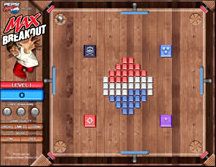 Breakout is a twist on one of the oldest gameplay formulas in videogames, and it is surprisingly difficult. Instead of controlling just one paddle, you control four, and all of them with the mouse. Moving the mouse to the left and right move the top and bottom paddles, while moving the mouse up and down move the right and left paddles. Not only does the control scheme seem a bit odd to describe, playing it is a similar experience that challenges your hand-eye coordination skills. The object, of course, is to keep the ball on the play field, which is in a top down perspective. To add some variety, four power-ups exist to change up the play, such as: multi-ball, laser paddle, and big paddles. Click.
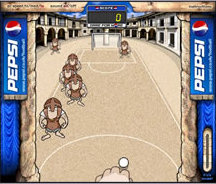 Finger Footy is a fun and humorous game that pits you against a whole football team—that's soccer to us Americans. The object is to try to score goals by getting the ball past the oncoming players, all the while preventing the players from getting too close by bowling them over with the ball. Control is with the mouse, click and hold the button down to power up your finger to flick the ball down the play field. Scoring a goal nets 15 points, and 1 point each for every player you knock over. It's a cute game that gets more difficult as the big guns come out later in play. Click.
Update: Unfortunately, Pepsi UK has taken these games offline to make room for another promotion.


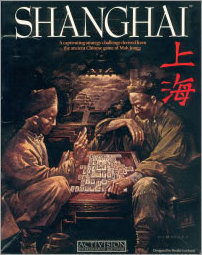 Almost twenty years ago, I would often play a solitaire game on the Mac called Shanghai that used Chinese Mahjongg tiles for play. Created by Brodie Lockard and released by Activision in 1986, Brodie is credited with the original idea, programming and artwork for the game. Since then there have been many clones and copycat versions, but most still rely on the same tile-matching and removal gameplay. Considered a meditative strategy game, Solitaire Majongg is played with a standard set of Mahjongg tiles stacked on the play field in a precise formation. The rules of play dictate that you can remove two like tiles from play only if each tile is "free"—meaning there is no other tile physically on top of either one, and they can each be slid freely off the stack either to the left or right. To win, you must remove all 144 Mahjongg tiles from the play field.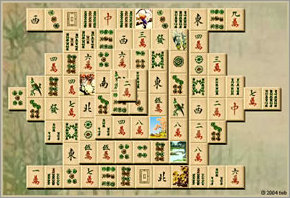


 There is something I need to warn you about, especially if you have thought about trying the multiplayer game I posted a couple of days ago called





Recent Comments