
What Sports Management Games Teach Us About Uncertainty, Trade-offs and Better Decisions
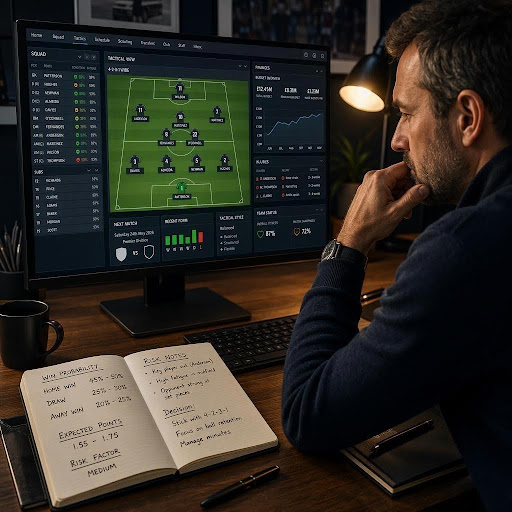
A good sports management game has a funny way of making you care deeply about decisions that, on paper, sound quite ordinary.
Do you sign the promising midfielder with patchy fitness? Rest your leading scorer before a difficult fixture? Spend most of the wage budget on one established name, or build a deeper squad with fewer obvious stars?
Then the match engine gets involved, an underdog pinches a draw, and suddenly every choice feels enormous.
That's the appeal. Sports simulations turn planning, uncertainty and limited resources into something you can test. You're not merely picking a team, you're making predictions with incomplete information, then seeing how events unfold. It's a remarkably approachable way to learn about odds, risk and the difference between a sensible decision and a fortunate result.
Why every choice feels as though it matters
Sports management games make consequences visible. Your squad selection affects fatigue, morale and tactical fit. Your budget affects who stays, who leaves and which gaps remain unfilled. One injury can alter an entire season.
Real sport works that way too, of course, though simulations make the moving parts easier to inspect. You can often see form ratings, player attributes, fixture congestion and reports in one place. That doesn't make outcomes predictable. It simply gives you better questions to ask.
For example:
-Is this player's recent scoring run likely to continue?
-Have we seen enough matches to judge a new formation?
-Is a narrow loss evidence that the plan failed, or just one awkward result?
-What is the cost of taking a risk now?
I find that the best management games gently push you away from gut feeling alone. You can still take a punt on an untested prospect, but you'll usually do it with a clearer sense of what might go wrong.
The game-first basics: squads, simulations and tight resources
Before getting too philosophical about probability, it helps to look at what these games actually ask you to manage.
Building a squad is an exercise in trade-offs
No roster is perfect. A strong squad may lack pace in defence. A talented attack may be short of cover if injuries arrive. A veteran might offer reliability but leave little room for development.
The important lesson is that decisions should be compared against realistic alternatives, not an imaginary perfect option.
Suppose you need a defender. Rather than asking, "Is this player good?", try:
-What problem does this signing solve?
-What does it prevent us doing elsewhere?
-Who are the alternatives at a similar cost?
-What happens if the player is unavailable for several matches?
-Would the squad still make sense after the deal?
That's practical risk management. It isn't about never making bold choices. It's about understanding the compromise attached to each one.
The match engine is not a promise machine
A match engine translates ratings, tactics, conditions and random variation into a result. You might dominate possession and still lose. Your side may scrape a win despite looking second best for long periods.
That can feel unfair, but it's also the point.
A simulation's result is an output from a system, not a guarantee that the "best" side wins on every occasion. Sports are full of low-probability events, deflections, mistakes, injuries and moments where a plan meets reality rather messily.
This is why score predictions are useful only when treated as ranges rather than certainties. "We're more likely to win than lose" is a very different claim from "we will win 3-1".
Constraints make judgement meaningful
The best saves rarely begin with unlimited resources. You have a wage ceiling, a transfer budget, a finite number of staff slots, tired players and fixtures that refuse to space themselves politely.
Those limits encourage sharper choices:
-Prioritise the positions that most affect the team's structure.
-Keep some room for unexpected problems.
-Avoid using every available resource just because it's there.
-Decide which risks are acceptable before a crisis forces your hand.
Management simulations belong to the broader family of games built around limited resources and ongoing planning. As this overview of construction and management simulations notes, resource decisions are often central to the genre. In sport, the resources happen to be players, time, fitness, scouting knowledge and patience.
Probability literacy, learned one match at a time
A football season, racing calendar or league campaign gives you plenty of chances to misunderstand probability. That's not a criticism, most of us do it. Our brains love neat stories, particularly after a dramatic result.
Games offer a low-stakes place to spot those habits.
Variance can make good plans look bad
Variance is the natural spread of possible outcomes. A stronger team may lose a single match. A player with an ordinary shooting record may score a spectacular hat-trick. Neither event rewrites everything you knew beforehand.
If your strategy produces good chances across ten matches but the results are mixed, it may be too early to rip up the plan. Equally, a winning run doesn't automatically prove every decision was brilliant.
A useful question is: what evidence would change my mind?
That keeps you from treating one result as a final verdict.
Sample size matters more than a hot run
A small sample can be noisy. Three excellent performances may be encouraging, but they don't necessarily tell you as much as a full season. The same applies to a new tactic, a player's form, or a score-prediction method.
When reviewing a decision, separate:
-What happened: the final score, league position or individual performance.
-What was known at the time: injuries, form, opposition strength and available options.
-What repeated evidence says: results across a meaningful number of comparable situations.
That middle point is easy to forget. It leads directly to hindsight bias.
Hindsight bias makes everything look obvious afterwards
Once you know the result, it's tempting to believe you "knew it all along". A failed transfer becomes clearly foolish; an unlikely win appears inevitable because you noticed one encouraging statistic.
But decisions must be judged using the information available before the result. If you chose a sensible formation based on your players and the opponent, a late own goal doesn't suddenly make that choice irrational.
Try writing a short pre-match note in your save:
We're starting the slower centre-back because the opponent's main threat is aerial rather than pace. The plan may struggle if they bring on quick wide players.
Afterwards, compare the note with the result. You'll learn far more than by relying on memory.
A simple toolkit for clearer decisions
You don't need a spreadsheet with fifty tabs to think more clearly, although nobody's stopping you. A small routine is enough.
Compare options before committing
For major choices, make a quick table or note with three headings:
| Option | Upside | Main drawback |
| Sign an experienced player | Immediate consistency | Less room in the budget |
| Promote a younger player | Development and flexibility | Less proven performance |
| Change formation | Could suit key players better | Takes time to assess |
The goal isn't to remove uncertainty. It's to stop uncertainty being invisible.
Set limits before the decision gets emotional
Limits can be practical rather than dramatic. Decide in advance:
-the largest portion of the budget you are willing to allocate to a single transfer,
-the number of matches you will play before reviewing a new tactic,
-the cover you want for each position, and
-the conditions that would make you walk away from a deal.
When a deadline day offer appears or a key player asks for more money, pre-set limits can save you from making a choice you wouldn't make on a calmer day.
Track assumptions, not just results
Write down the claim behind the choice.
-"This winger's pace will create more chances against a high defensive line."
-"Rotating now should reduce fatigue later in the month."
-"This opponent has conceded from set pieces, so we'll focus on delivery."
Then review it. Was the assumption reasonable? Did the match provide enough evidence? What would you do differently next time?
That habit turns a frustrating defeat into useful information.
A JayIsGames-style corner of the web to explore
If you enjoy the idea of managing sporting decisions without needing a massive installation or a free weekend, browser and indie games are well worth a look. They often focus on one satisfying loop: balancing a squad, predicting a score, managing a season or solving a sporting scenario.
For a broad starting point, Jay Is Games remains a handy archive for browser and indie discovery, with reviews, tags and reader discussion that can lead you towards smaller games you might otherwise miss.
A few worthwhile directions to explore:
Browser football management games: look for short season formats where squad rotation and tactics matter more than endless menus.
Score-prediction challenges: these are useful for practising probability language. Predict in ranges, record your reasons and notice where confidence was misplaced.
Fantasy-style roster puzzles: a compact way to weigh fixtures, player roles and limited selections.
Indie management simulations: search the Steam sports category or itch.io's sports collection for unusual takes on coaching, club ownership and tournament organisation.
Classic management series: established simulations can offer deeper databases and longer campaigns, though a small indie title may teach the same decision-making lesson in twenty minutes.
When browsing, don't worry too much about whether a game looks realistic enough. A stripped-back management game can be excellent at showing opportunity cost. If you can only recruit two people, change one variable, or make one prediction, every choice becomes easier to examine.
Adult readers (18+ where legal): sports-betting resource
For eligible adults in jurisdictions where it is legal and regulated, MONOPOLY Casino sports betting is a jurisdiction-dependent reference point for sports-betting information. It is separate from sports simulation play, and neither activity provides certainty about sporting outcomes.
If you choose to visit any regulated betting service, check local eligibility requirements and use the responsible-gambling tools available, such as deposit, time or account limits where offered. Keep participation within limits you set beforehand, and stop if it no longer feels like a comfortable leisure activity. The Gambling Commission's safer gambling guidance is also a useful UK reference.
Take the lesson back to the save file
Sports management games are at their best when you treat them as a place to experiment.
Try the unfashionable formation. Give the academy player a run. Compare two recruitment approaches over a season. Make a prediction, write down why you made it, then revisit it after the result.
You won't remove uncertainty, and that's not really the aim. The useful skill is learning to make calmer, more informed choices while accepting that a single result can still surprise you.
That makes the next difficult fixture more interesting, not less.



Update