
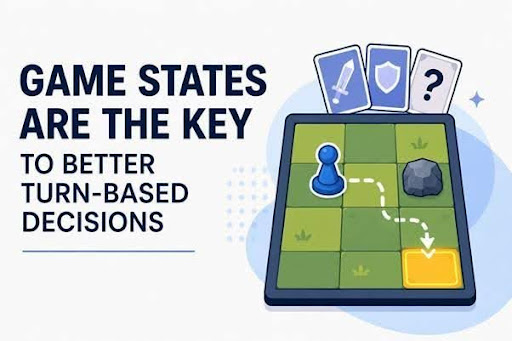
A turn-based game is not solved one move at a time. It is read one position at a time. The best players notice what the screen, hand, board, or grid is saying before they touch anything at all. A game state is that living snapshot: what is visible, what is hidden, what just changed, and what the next action will leave behind.
That is why the same move can be brilliant in one moment and pointless in the next. It is well-established that adults learn many skills through gaming, which helps explain why good play feels active, even when the rules are simple. The player is not just reacting to a screen. They are sorting signals: open space, blocked paths, remaining turns, card order, enemy timing, and the small changes that make the next choice clearer.
Reading the Board Before the Next Move
Poker is a useful card game example because the state of a hand keeps changing, while the same decision thread continues in sequence. To see that in a real format, check out Bovada Poker, which lists Texas Hold'em, Omaha, Omaha Hi-Lo, tournaments, cash poker, Zone Poker, mobile poker, and Practice mode, giving readers a practical setting for observing how board state works in cards.
Before the flop, a player is reading hole cards, position, and early action. On the flop, shared cards reshape the possible hands. On the turn and river, one new card can change the texture of the board, narrow the range of likely holdings, or make a previous choice look different. Bovada's poker collection works as a direct reference point for this because it provides players with a wide variety of poker variants to choose from, giving them lots of different situations to observe.
Perhaps surprisingly, the same habit of reading a changing state carries into other chance-based games, such as slots. This article on crypto casino games for the Lunar New Year shows this through titles such as Cai Fu Dai Panda, Phở Sho, and Da Hong Bao. Cai Fu Dai Panda is described as a five-reel, four-row slot with coin-triggered feature events. Phở Sho highlights Sticky symbols, Food Scatters, Hold & Win moments, and feature spins. Da Hong Bao uses Wilds, Lucky Spins, Fortune Spins, and Dragon Spins. These examples are useful from a game-design view because each feature changes what the player is looking at on screen, ensuring they spend time reading the game state and understanding what is going on.
The Four Questions Behind a Strong Turn
A good game state can be read through four simple questions:
-What is visible now?
-What has changed since the previous turn?
-What information is still missing?
-What will this action make possible next?
Those questions work across puzzle grids, tactical RPGs, card games, and compact browser games. In a sliding-block puzzle, the most important thing to notice about the visible state may be a single exit path blocked by one awkward piece. In a tactics game, it may be a weak enemy standing one square too far from cover. In a card game, it may be a newly revealed card that changes your whole approach.
This is also why turn-based decision-making is satisfying. The player gets time to notice. There is space between action and consequence. Instead of a reflex test, the turn becomes a small act of interpretation.
Tiny Changes Make Big Differences
Small changes matter because turn-based games are built on relationships. A tile is not important by itself. It matters because of what it blocks, opens, threatens, or protects. A card is not only a card. It belongs to a hand, a board, a possible sequence, and a set of unknowns. A cooldown is not just a number. It is timing, pressure, and opportunity folded into one marker.
This is why a sparse board can still feel tricky to process, while a crowded board can sometimes feel easily readable. Complexity is not about how much is on screen. It is about whether the player can understand what each element does to the current state. The most elegant games teach this without stopping the action. They let the player try, watch the result, and revise their reading.
Why Game States Make Play Feel Alive
Game state is the reason that turn-based games can feel calm and intense at the same time. The player is allowed to pause, yet the position still carries pressure. A puzzle waits. A card hand develops. A tactical map holds its breath. A bonus screen updates as symbols lock, rows shift, or features begin.
The best part is that this way of reading games does not make play colder. It makes it richer. You notice the craft behind the moment: the board that teaches without lecturing, the hand that changes meaning by the river, the tiny rule twist that makes an old mechanic feel new.
A 2023 Frontiers in Psychology study on how game features influence attention in adults also points to feedback, reward, storyline, competition, and aesthetics as features that can shape attention differently across players, which fits the heart of turn-based play. The current state gives the player something to read, and the next move gives the game something to answer.



Update