
The Paradox of Too Many Games: Why Finding Your Next Favorite Is Harder Than Ever
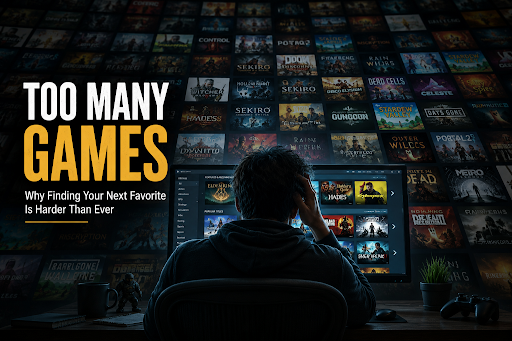
There's a ritual most PC gamers know well. You sit down with an hour or two to kill, open your library, scroll through a wall of titles, and somehow end up watching someone else play on YouTube instead. It's not that there's nothing to play -- it's that there's too much. The sheer volume of options creates a kind of decision paralysis that didn't exist fifteen years ago, when your choices were whatever sat on a shelf at GameStop or whatever popped up on a Steam sale.
The numbers back this up. Steam alone added over 14,000 new titles in 2025. That's roughly 38 games per day appearing on a single storefront. Factor in Epic, GOG, itch.io, and the dozens of independent platforms hosting free and pre-installed games, and the total becomes almost absurd. For players, this should feel like a golden age. Instead, it often feels like standing in front of a buffet so massive that you lose your appetite.
Discovery Is Broken -- And Everyone Knows It
The standard approach to finding new games hasn't evolved much. Most storefronts rely on algorithms that show you variations of what you've already played. If you bought two RPGs last year, your recommendations are wall-to-wall RPGs. The "Popular" tab surfaces whatever's trending globally, which usually means the same five AAA launches that are already dominating every gaming subreddit and Twitter feed. And the search function -- well, try searching for "atmospheric puzzle game with a good story" on any major storefront and see what you get.
The problem isn't that good games don't exist. It's that they're buried under layers of noise, and the tools we have for cutting through that noise were designed for a catalog of hundreds, not tens of thousands. A player looking for something specific -- say, a short horror game they can finish in an evening, or a strategy title that runs on older hardware -- has to do real excavation work. Forum threads, curator pages, Reddit recommendation posts from three years ago. It works, but it's slow and unreliable.
This is especially frustrating for anyone trying to explore outside their usual genres. The algorithm won't help you discover that you love city builders if you've only ever played shooters. That kind of cross-genre discovery almost always comes from a friend's recommendation or from stumbling across something unexpected -- which is hard to do when every platform is funneling you down the same narrow path.
What Actually Works: Curation Over Algorithms
The platforms that are solving this problem aren't doing it with better algorithms. They're doing it with structure. Hand-organized libraries that let you browse by genre, popularity, file size, or release year. Curated collections that group games around themes instead of dumping everything into one alphabetical list. Trending pages that show what real players are actually downloading right now, not what a recommendation engine thinks you should try based on your purchase history.
It's the difference between walking into a bookstore with a knowledgeable staff versus searching Amazon's infinite catalog. One gives you direction. The other gives you options -- which isn't the same thing.
Some of the most effective examples of this come from platforms you might not expect. SteamUnlocked, for instance, organizes its entire library -- over 22,000 titles -- into browsable categories, alphabetical indexes, and genre-specific collections. But the real value isn't the sorting itself. It's that every game is pre-installed and ready to launch immediately. There's no installer, no dependency hunting, no "which Visual C++ version do I need" troubleshooting. You download, extract, and play. That zero-friction approach changes how people interact with a library this large, because trying something new costs you nothing but bandwidth.
Their trending page is a good example of curation done simply. Instead of relying on an opaque algorithm, it surfaces what's genuinely popular across the platform in real time. For someone who doesn't know what they want to play -- which, honestly, is most of us most of the time -- that kind of social signal is more useful than any personalized recommendation.
The Forgotten Catalog: Why Older Games Keep Disappearing
There's another dimension to the discovery problem that doesn't get enough attention: preservation. Games from the late 2000s and early 2010s are quietly vanishing from official storefronts. Publishers let licenses expire. Server-dependent features get shut down. Delisting happens without fanfare -- a game is just there one day and gone the next. According to a Video Game History Foundation study, an estimated 87% of classic games are out of print and largely inaccessible through legitimate channels.
This matters because some of the best gaming experiences of the past two decades aren't the ones that made the most money. They're the mid-budget titles that took creative risks, the indie projects that never found a mass audience, the licensed games that were surprisingly good but got pulled when the IP deal ended. These games don't have marketing budgets keeping them visible. Without platforms that actively maintain and organize large back-catalogs, they effectively cease to exist for new players.
The irony is that older games are often a better fit for discovery-minded players. They're smaller downloads, they run on modest hardware, and their design sensibilities are different enough from modern titles to feel genuinely fresh. A player who's burned out on 80-hour open-world games might find exactly what they need in a tight, 6-hour adventure game from 2011 -- if they can find it at all.
Why Friction Matters More Than You Think
The biggest barrier to trying new games isn't price. It's friction. Every extra step between "that looks interesting" and "I'm playing it" reduces the chance someone follows through. Install wizards, dependency checks, compatibility troubleshooting, account creation -- these aren't huge obstacles individually, but they stack up. Multiply that by every game someone considers trying, and the math works against exploration.
This is why pre-installed game libraries have grown so quickly. They collapse the entire process into a single step: download and play. Console players have had this experience for years -- you buy a game, it works. PC gaming historically traded convenience for flexibility, but that trade-off is becoming unnecessary. When a platform handles configuration before the download even begins, the flexibility remains without the hassle.
The practical effect is that people try more games. When there's no setup cost, the threshold for "I'll give this a shot" drops dramatically. That ten-minute curiosity window -- where you saw something interesting and want to check it out before the impulse fades -- becomes viable. And that's where the best discoveries happen. Not from careful research and deliberate selection, but from low-stakes experimentation.
The Best Era of Gaming Is a Discovery Problem
We're living through the most abundant period in PC gaming history. More games are available, in more genres, at more price points (including free) than at any previous moment. The creative output is staggering. The quality ceiling has never been higher, and the variety has never been wider.
But abundance without navigation is just noise. The platforms and communities that will define this era aren't the ones with the biggest catalogs -- they're the ones that help players find the right game at the right time. Whether that's through thoughtful curation, community-driven trending data, frictionless access, or simply maintaining libraries that others have abandoned, the value is in the filtering, not the volume.
The next great game you'll play probably already exists somewhere in a library you haven't explored yet. The challenge isn't finding more games. It's finding the one that's been waiting for you.


Update