
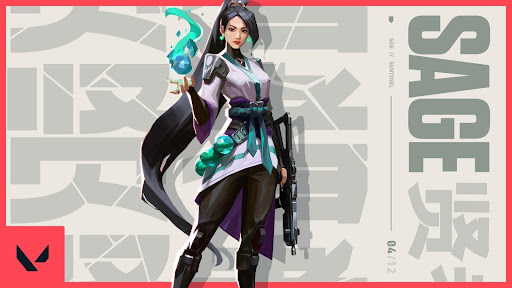
If you decide to play sage valorant, then expect to be the player who stabilizes rounds. There's no need to frag the enemy to carry, because your role is to maintain numbers, hinder enemy advance, and create situations that your teammates can turn out to win. This kind of consistent impact is exactly what matters if you're trying to climb the ladder efficiently, with some players even considering options like Valorant Boosting to speed up the process.
Sage valorant can make safety in all senses because she heals, makes zones unpassable, and brings back teammates. When played right, sage valorant provides a safe and secure anchor in any crazy round.
Who is Sage in Valorant
Sage valorant is a Radiant and a Sentinel agent coming from China. Her full name is Wei Ling Ying. In lore, she is depicted as a calm, composed and responsible individual whose duty is to make sure that the group does not break up when their plans fail.
To Riot Games, sage valorant represents a simple concept - she is an agent creating security for herself and teammates on every map. This makes her one of those agents who excel in both coordinated and solo queue games, because she is always valuable when you have enough time for her abilities.
If you are a beginner and are deciding whether or not to play sage valorant, then imagine the support class who can take fights and win them if he chooses.
What are Sage's Abilities in Valorant?
Sage's abilities are straightforward on paper, but timing and placement are everything. Her kit is built around delaying space, repairing damage, and swinging a round with her ultimate ability.
Healing Orb
Healing Orb is Sage's signature ability and it's the reason teams love having a Sage. The healing orb ability applies heal over time, either to a teammate or to you.
-If you target a damaged ally, you get an ally heal that can bring them back to full health if they weren't too low for too long.
-If you're the one who got tagged, you can self heal.
Mechanically, sage's healing orb has two inputs: FIRE heals a teammate, and alt fire heals you. That matters because you should decide fast, then get your gun back out.
If you're wondering how much Sage heals in Valorant, the practical takeaway is this: ally healing is much stronger than self-healing, so don't autopilot the selfish heal unless it keeps you alive for the next few seconds.
Quick habit that wins rounds: call it. "Heal in 3" or "I can't heal yet" prevents teammates from taking an extra duel expecting a miracle.
Slow Orb
Slow Orb is your space-tax tool. You throw an orb forward that detonates upon landing creating a lingering field of ice. That lingering field does two things: it slows players caught inside and it makes them loud, which is huge for info.
The key detail is the throw pattern: you're basically sending a slowing orb forward into a choke, a doorway, or a common swing. Use it when you want to:
-Stall aggressive pushes
-Punish a fast hit
-Make a retake awkward by forcing enemies to either wait or stomp through noise
One common mistake is throwing it too deep. If the slow is behind the enemy, it doesn't matter. You want it where they must cross.
Barrier Orb
Barrier Orb is the iconic ice wall. The barrier orb ability lets you place a solid wall that blocks movement and sightlines, and it changes how a whole round plays.
Core mechanics you should know:
-FIRE places a solid wall at the target location.
-Alt fire rotates the placement preview, so alt fire rotates the wall to fit the angle you actually need.
That barrier orb wall can be used in three main ways:
-Delay: block enemies at a choke so your team can rotate.
-Protect: create cover for a plant, defuse, or a revive attempt.
-Create: build an off angle for yourself or a teammate.
Don't treat it like a "start of round only" button. Often the best wall is the one you save to block enemies during a late execute or to seal off a retake route.
Resurrection
Sage's ultimate skill set makes it one of the most powerful round-warping tools. Sage will aim their resurrect on an enemy, then start resurrecting them. They have some time to channel, and if the process is complete, their teammate rises with full health.
There are two things that define Sage's ults:
1. Never resurrect in an exposed position. You will stay committed to the process and will be unable to avoid damage.
2. Always think about your resurrection purposefully. Sometimes the best decision is a duelist with utilities, other times it's a control with smokes, or simply anyone who is capable of shooting.
It's always good to wall before ressurecting. It's possible to combine an orb wall and a resurrect. Remember that you are still vulnerable to spam and utility.
What is Sage's Role in Valorant?
Another valorant agent who fits in "second contact" very well is Sage. She is neither too far away to be of use but not too close to die before utilizing her kit.
Most rounds will involve you doing something along these lines:
-Keeping one team member alive for the next clash
-Holding enemy pushers off long enough for rotations to arrive
-Reversing an unfavorable number advantage by having the capability to revive downed teammates
Sage on defense tends to hold a defensive position for as long as she can. On offense, she becomes a key factor in making the execute safer while protecting the plant from getting executed.
A minor change of perspective goes a long way here: she does not heal the HP but manages the tempo by providing value even when never pressing any heal via a properly timed slow and wall.
Sage's Appearance and Skins in Valorant
Sage from valorant is instantly recognizable: white and teal robes, jade-like accents, and the orbs that visually tie into her ice wall and healing theme. Her design leans into the calm, monk-like vibe, which matches her "calm center" identity in lore.
For skins, Sage herself doesn't swap outfits the way weapons do, but players usually build a "Sage loadout" by pairing her with clean, elegant weapon collections and matching buddies or cards. If you care about aesthetics, try to keep your crosshair and weapon VFX readable, since Sage often plays around tight cover and utility timing.
Advanced Sage Valorant Strategies for Ranked Success
A good Sage heals. A great Sage wins rounds by making the enemy waste time and making your team take cleaner fights. This is the part of the sage valorant guide that matters most for ranked.
Wall for Time, Not Just for Blocks
Sure, walling may help prevent enemy players from coming closer. Still, there is something even better - forcing them to waste their ammunition and utilities to breach that solid wall in exchange for mere 400 credits.
Useful walling examples include:
-Walling a choke point once you hear the steps of several players, then taking cover from a better angle
-Walling a spike plant to force a specific timing on defense
-Using walls on narrow corridors to divide one push attempt into two
Use Slows to "Shape" Fights
Slow Orb can do wonders if used wisely. Place it in such a way that forces your enemies to:
-Wait until it disappears to regain their momentum
-Walk through it to provide you with audio clues
Placing Slow Orb near the spike in post-plant phase may result in victory without any duels whatsoever.
Revive with a Plan, Not a Prayer
If you have enough ultimate points, go for Resurrection, and think thoroughly about its potential outcome. Ask yourself:
-Do we have enough people to cover the body while you resurrect an ally?
-Are enemies close enough to start the ultimate instantly?
-Will the revived player have a chance to grab his gun and take cover after the resurrection?
Remember that sometimes holding your rifle up is the best thing you can do, even with all the points and ultimate prepared for the game.
Simple Map Callouts that Matter
Don't create a huge playbook for yourself; instead, try to make a few useful callouts during each match:
-Inform your teammates about your walling intentions in advance to avoid getting stuck behind it
-Call slow timing out loud to prevent your Duelist from dashing straight towards your Ice Block
-Remind your teammates about your healing cooldown to stop them from requesting a revive mid-fight
No matter how messy and chaotic a situation is during a hectic round in solo queue mode, proper communication will make everything easier.
How to Improve as Sage Valorant Player
Improvement in Sage valorant isn't always about creating clips but rather mastering decisions. Here are the things you should pay attention to when wondering how to play sage valorant better:
1. Play cover and trade for as long as possible until your first heal expires
2. Choose your heal target wisely: it should be the most likely to fight next. When the entry hits the site in A-round, for instance, it would be a good idea. Self-healing might come only as a measure to prolong life.
3. Hold wall for later as much as possible to avoid walling prematurely, which is usually a bad idea.
4. Always place slow orb and then hang out on the side. Most players tend to become too impatient to pass this blockade and give you a chance for kill.
5. Analyze your mistakes and fix just one every time you train
Master the art of Sage decision-making, and you'll find yourself to be the best support agent on the map.



Update